-
These thoughts are super scattered and don't really follow any logical progression - this isn't a finished piece yet. But there are some standalone concepts that I've wanted to share with friends.
-
The business as an information system
-
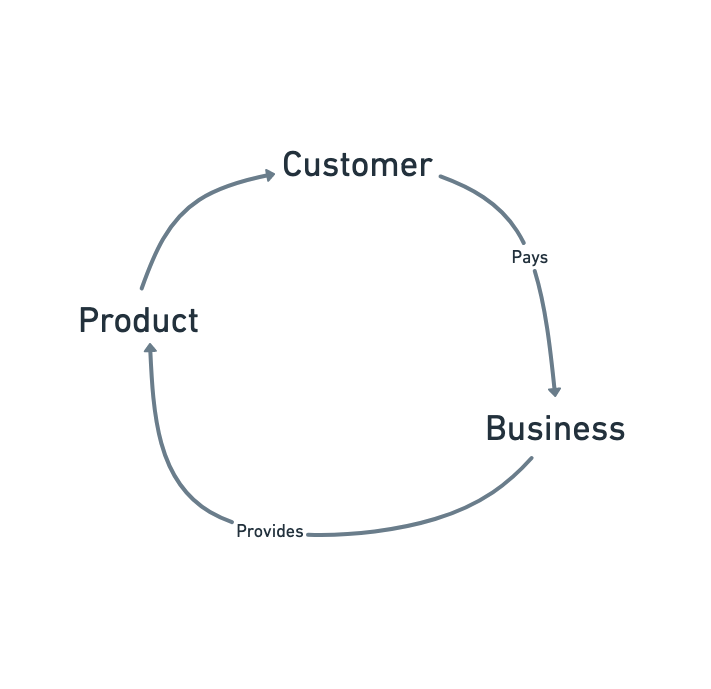
Once a product is built and unit economics are proven, a business is basically an information system whose function is to convert consumer interest into dollars.
-
This is the simplest possible representation of that system
-
-
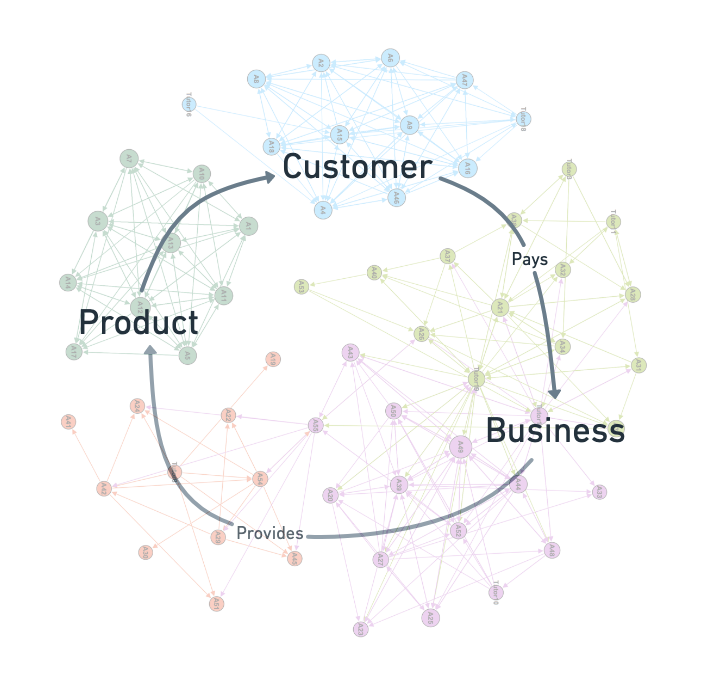
In reality for any business of scale the real diagram is a graph as opposed to a loop. But in theory it should be possible for any business to map all of the edges and nodes through which information flows in order to go from consumer-interest to money-changing-hands.
-
-
Some of the duties a business needs to perform
-
Primary: Reach and convert customers; Provide product or service
-
Secondary: If it operates within a regulatory environment, fulfil it’s regulatory duties; If it employs people, fulfil it’s human duties
-
In the above diagram, each node is a decision point - a juncture at which, in order for the information to keep flowing through the system, a judgement must be made, and each edge is just information flowing from one decision point to another.
-
The internet is, by several orders or magnitude, the single most transformative thing to happen to commerce (bigger than the industrial revolution) because:
-
If you consider that the system’s job is to convert consumer interest to dollars, the internet is an on-demand “tap” that can, if utilised correctly, provide a single stream of unified, non-geographically-constrained consumer interest that moves at the speed of bits, not atoms. It is a marketplace of billions.
-
If you consider that, as a business grows, all that’s happening is that information is flowing through its nodes and edges, then the most important activity, by far, is optimising the speed of information flow through the system. The faster the information flows, the more revenue the organization will make and the faster it will scale (keep in mind this is accounting for preserving unit economics and regulatory/human duties.)
-
Nodes and edges
-
There was a point in history at which both the nodes and edges in these systems were completely comprised of humans. Once a decision had been made, to get that information to the next node, a human had to physically travel to pass along the message. When telecommunications came along that constraint was removed, and now most edges are electronic and thus move instantaneously.
-
When it comes to nodes (decisions), to this day, most are still human based. But my gut tells me that 90%+ off those decisions can (and should) be programmatised.
-
The best example of the power of programmatising these edges (thus removing the human bottlenecks) are our payment rails - i.e. Stripe. For most of history, payments from one account to another would need to be “signed off” by a human.
-
-
What is the maximum amount of value that can be packed into one decision?
-
Any node (decision point) which can be converted to a contract should be.
-
The Learnings
-
More humans = more decisions. A simple way to increase the speed of information through the system is to replace human decision points (which can takes weeks or months) with automated decision points that take seconds.
-
-
I’ve had these ideas swirling around for a while now but they hadn’t fully crystallised. Some recent anecdotes that triggered me to write this were:
-
Came across a quote which goes something along the lines of "The mark of a good governance system is that you could allow your enemies to run it and trust it would still work"
-
I listened to this podcast with the guy behind “Sweaty startups”. What he and his business partner do is: Buy small-scale storage facilities, increase their net profit by removing the full time staff and digitizing them - install an automated security system etc. so they can be left unmanned. They have 3 full time employees who run customer support from home, are making 250k/year salaries, and now own very large real estate assets that they took no risk on. His whole brand is “low risk entrepreneurship”.
-
I was thinking more about “commoditization”. The following is how I personally would define it:
-
The commoditization level of a process can be measured by the ratio of experts to non-experts required to keep it operating functionally.
-
The level of commoditization of a process is usually a function of
-
The amount of human decision-making or skill required (and the amount of expert human decision-making or skill) to complete the process.
-
The amount of time that the process has existed, measured in years.
-
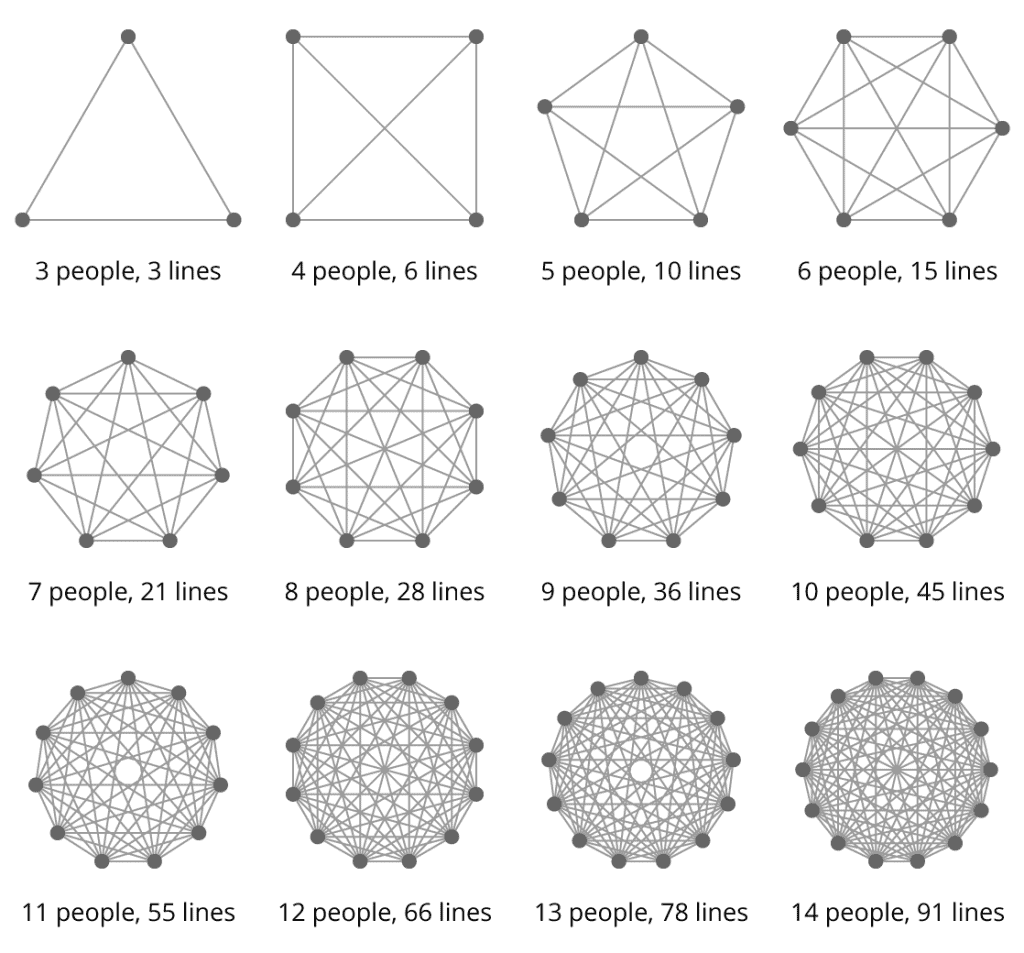
The level of interdependence of each of the isolated parts. Interdependcy-related complexity grows exponentially. The following image illustrates this very well.
-
-
-
For example - the first cars were built by experts - people who understood from first principles how every part worked. Over the next several decades, the entire process was broken down into smaller pieces that could be undertaken by non-experts. The production of cars still requires experts involvement, but I’d estimate the ratio of experts:non-experts now required to produce a single car end-to-end is probably 1:1000, maybe much higher.
-
Another anecdote here is to compare building large-scale consumer software to building a skyscraper. Large scale consumer software is about 10 years old - you will not find a single team that doesn’t have at least one senior developer for every 3 to 4 mid-level developers (1:4 ratio). The higher the ratio of a software teams experts:non-experts, the higher the likelihood that they are working on software that has been around for a long time, or software that directly mirrors a real-world process that has been around for a long time.
-
There are 2 relevant areas of commodization
-
The product or service being offered
-
The organizational pieces required to offer that service
-
Quick brain dump on internal orgs/activities and commoditization level
-
More commoditized
-
Lead generation
-
Cold email outreach
-
Sales (needs labour but can still be playbook driven)
-
One of the most commoditized organizational functions. The concept of salesperson was around long before web software was a thing, and within software and saas, sales is probably the function that has been studied and commoditized (AE, SDM) the most.
-
-
Customer Support
-
Finance & accounting
-
-
Less commoditized
-
Customer research
-
Product design
-
Branding
-
-
-
-
-
-
-
Posit
-
A software company that is doing something that’s only been a thing for less than 10 years will need a low expert:non-expert ratio (1:5) to continue to operate effectively. An obvious category here is software that sells to other software companies - e.g. live-chat, developer tools etc.
-
A software company that is digitising a real-world process that has been *a thing* for several decades can operate with a higher expert:non-expert ratio, because the rules for what the product needs to do are already known, and the bar for the product experience is not as high as pure-software experiences. The customer is not buying the experience of using the product - they’re buying it purely for the productivity gains, and because there’s a direct real-world analogy, they have a very tangible basis of comparison.
-

Tony Ennis